Friday, January 21, 2011

Japan Loves Vintage!


Earle Goodenow, Cow Concert, 1951 

Looking around Japanese websites is often a frustrating experience for me.
Most of the times the pictures are impossibly small, and the language
an insurmountable barrier (Goggle translator is not much help in this case).
Still, with patience and a bit of luck there are many unusual treasures
to be found. Soramimibunco is a Japanese store packed with interesting 
vintage children's books from the 1950s to the 1970s. As you can see 
from these covers, most seem to have been discarded by various 
American public libraries. Nice to think that they will fall in some 
loving collector's hands across the ocean rather than in the trash...

 Virginia Kahl, Away went Wolfgang!, 1954

Art Seiden, Counting Rhymes, 1959

 Jim McMullan, The Last Little Cat, 1961

 Judy Varga, Miss Lollipop's Lion, 1963

 Anita Lobel, Puppy Summer, 1966 

 Horst Lemke, Grisella the Donkey, 1967 

Mamoru Funai, The Runaway Giant, 1967 

Janosh, Gatalop The Wonderful Ball, 1971

 AIleen Fisher, Going Places, 1973 

 Albert John Pucci, Tailtwisters, 1973 

Eccles Williams, Magic at Midnight, 1974

Thursday, January 20, 2011

Prelude and Lullaby


I am finally feeling better, folks! 
Much gratitude to all who commented and wished me well!


From the You Tube notes uploaded by Animatsiya in English:

Norshteyn (Norstein) spent a year and a half making this animation 
for the introduction/conclusion to Good Night, Children (Спокойной ночи, малыши), 
a popular Russian nightly show for young children to watch before they go to bed. 
The first part would air before each daily show, the second part after.

The segment accompanied the show for a while in 2000, and was taken off the air 
in summer of 2001; the show moved to another channel while the copyright for 
the sequence stayed with the old one.

It was 81st on a list of the 150 best animated films ever made voted on 
by 140 animation professionals in Japan in 2003:
http://niffiwan.livejournal.com/7455....

However, the reactions of Russian audiences were largely negative; 
program director Valentina Prasolova said: "Norshteyn is a famous artist, 
but he does not make good opening/closing sequences. We get calls and letters every day
 about this sequence from people who tell us that it is terrible, that it is dark, 
that children do not want to watch our program."


Tired toys and books are sleeping
Blankets and pillows wait for children
Even the fairy tale goes to bed
So that we can dream it at night
Close your eyes, rock-a-bye

Rock-a-bye, all people must sleep at night
Rock-a-bye, tomorrow will be another day
We have gotten very tired today
So let us tell everyone "good night"
Close your eyes, rock-a-bye

Sunday, January 16, 2011

Sunday Sickness

Kitty Crowther

This week's safari is postponed due to a horrible flu.
Will be back as soon as I feel better!

Friday, January 14, 2011

A Nation at Play

Utagawa Yoshifuji, Toy zukushi, 1858

These images comes from the beautiful and fascinating Japanese popular prints 
by Rebecca Salter, kindly given to me by the lovely Susan Kelly. 
Susan is a former colleague and good friend of mine who currently lives 
in London and works at A &C Black, where she was the book's project's manager.
All the quotes in this post come from the author's very informative texts,
which explore various genres of popular prints and the social
and historical background from which they originated.

Utagawa Kunisada III, Kōshi Bath, 1882

"In this charming antrhopomorphic scene, mice replace humans
for a visit to the bath. Bathhouses were not only places to get clean, 
but also popular social venues and in some cases operated as brothels."

Utagawa Yoshifuji, Cat's Variety Show, early Meiji period

"A cast of cats attend a performance of a puppet ballad drama in a typical small 
playhouse – a contrast to the much grander (and more expensive) kabuki theatres."

Utagawa Yoshifuji, The Mysterious Cat from the 53 Stages, 1848-49

"Based in a scene from the Edo period playwright Tsuruya Nanboku's 1825
play of horror and ghosts Tōkaidō Yotsuya Kaidan ... The cat's face is made up 
from other cats, the bulging eyes from bells and the tongue from a cat's collar."

Utagawa Kuniyoshi, Cat Lover's Animal Puns of the Tōkaidō, 1847-52

"In this print, Kuniyoshi allocates a cat and a pun to each of the 53 stages of the Tōkaidō.
Puns have been made on each place name (some of them rather forced) and the cat
 illustrates the pun. ... Most of the cats shown are of the short tailed variety particularly 
popular with artists and courtesans in the Edo period."

Utagawa Kuniyoshi, Substitute Character Cats, c. 1844

"A combination of cats and blowfish (fugu) spell out the word 'fugu'. The well-known 
cat lover Kuniyoshi produced many works featuring cats, but this calligraphic series 
counts as one of his best. The final touch is the cat's collar complete with bell decorating
 the cartouche shiwng the artist's name and a fugu and fishnet device for the title."

Utagawa Kuniyoshi, Fish with Human Characteristics, early 1840s

"These fish portraits are Kuniyoshi's response to the clampdown on actor's portraits.
A well-known actor's face was grafted onto a fish body. In the presentation of these fish
 there is an echo of European natural history compendia which were known in Japan."

Kuniyoshi is believed to have created as many as 10,000 print designs.
See more of his wonderful works at the ongoing Kuniyoshi Project.

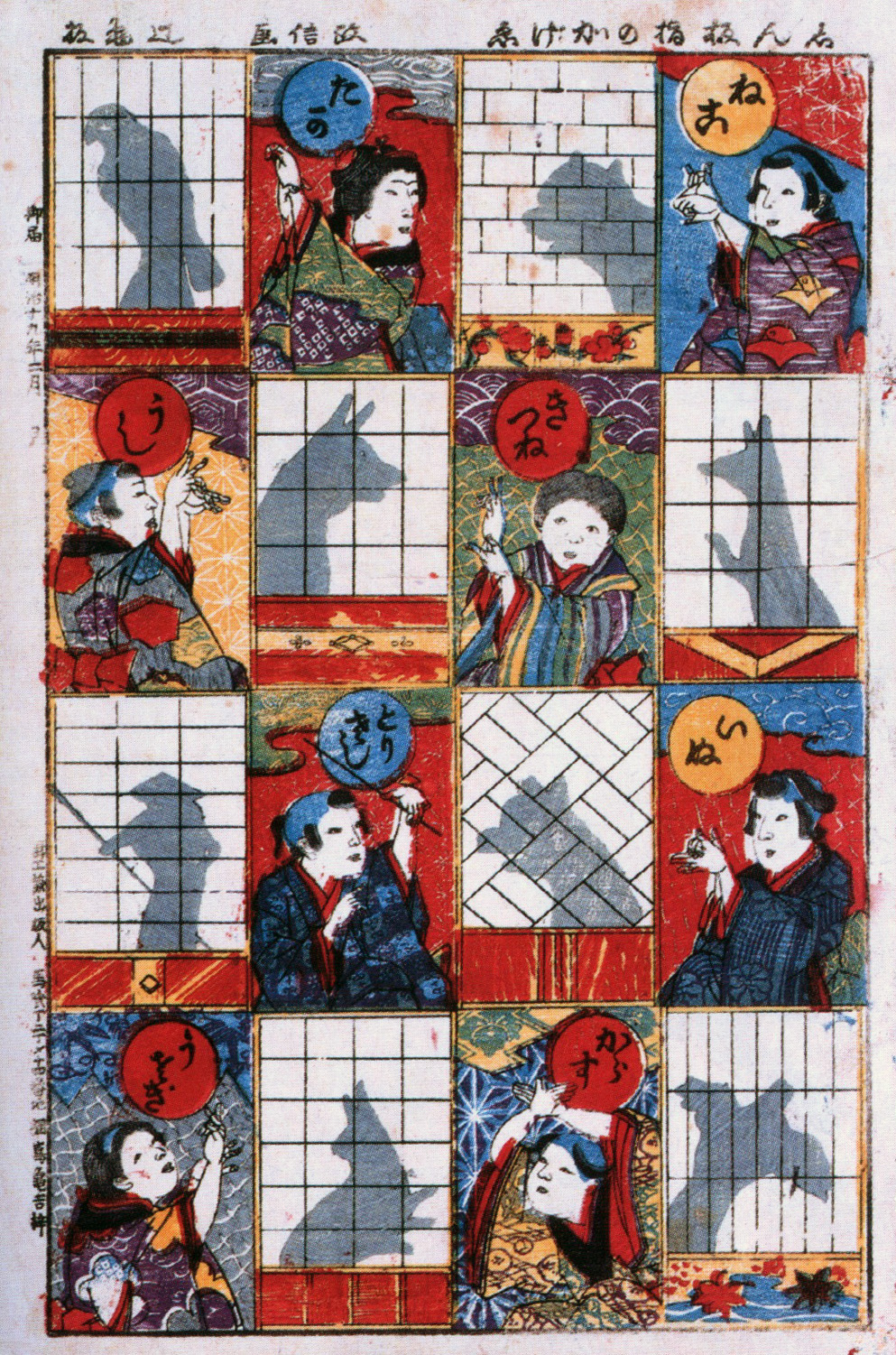
Anon., Parlour Shadow Pictures, 1885

"This toy print shows how to make simple hand shadows 
which any child could imitate."

Utagawa Yoshifuji, Horse zukushi, late 19th century

"Zukushi is not an easy word to translate, the best description perhaps
would be 'an enumeration of things. ... Zukushi are highly visual and consist
of single sheet prints with an arrangement 0f similar/related objects, 
sometimes with no words other than a simple title. They are like early 
pictorial encyclopedias and for children in particular, zukushi 
were an attractive and enjoyable way of absorbing information."

Utagawa Hiroshige II, Insect zukushi1848-53

"A classic zukushi-style enumaration of named insects. Even though it was 
designed for children, setting the insects against a woven bamboo background 
results in a sophisticated composition worthy of adult appreciation.
At the time, frogs and lizards were classed as insects."

 See more Zukushi prints at Ephemera Assemblyman.

Wednesday, January 12, 2011

Life is Change


I am very happy to be able to feature more elegant creations from one 
of my favorite artists, the lovely and mysterious Kazumasa Nagai.
These images span a period of almost 30 years, from 1969 to 2007.


LinkWithin

Related Posts with Thumbnails